

Like every year, CB Insight lists the technological innovations that should not be missed. Among others: AI in the service of immortality and domestic robots.
The tech trends of 2023 are numerous and sometimes difficult to oversee. Discover below the eleven technology innovation trends that will follow for 2023, according to the specialist company CB Insight, in a study released on January 4.
1. AI in the service of immortality
Many artificial intelligences have been working for years on adjusting cellular processes, regenerating certain parts of the body or discovering new medicines. A blessing for the digital giants. Altos Labs, a company backed by Jeff Bezos, closed a $3 billion funding round in early 2022 to develop “cellular rejuvenation programming.” Google is also in the running thanks to its investments in various companies, as shown in the graph below.

2. The explosion of substances based on biological materials
Promoting the biodegradable alternative to plastic through natural solutions such as mushrooms or marine algae: the stakes are high as brands such as H&M and Gap have committed to sourcing 45% of their polyester from recycled sources by 2025. The company Keel Labs has completed its fundraising with $17 million for its seaweed-based fiber production. MycoWorks, an American start-up, has conquered the luxury sector with its leather made from mushrooms, used by the French fashion house Hermès.
3. The rapid growth of super apps
Super apps, which bring together e-commerce, payment methods or even video games, are attracting more and more interest. The Gafam tries to push the concept of WeChat (Tencent’s application) further, without making pale copies of it.

Microsoft and Google are already looking to grow in the market by planning to use Bing and YouTube respectively as carriers for their future super apps. Several points for improvement have already been examined, including product deliveries and bank transactions. In October 2022, Twitter CEO Elon Musk appeased his desire to create a super app by announcing that “the purchase of Twitter was an accelerator to create X, the universal application.”
4. Preventive health applications continue to interest digital giants
Prevent instead of cure. This popular saying could well become the new playground of digital companies thanks to the development of sensors linked to preventive health applications. The example of the Sound Life Sciences start-up bought by Google is telling. By recording data from a patient’s breathing, a diagnosis of sleep apnea can be made. The data collected can also help patients with anxiety, asthma or lung disease.
Vocal biomarker technologies, particularly to prevent Parkinson’s disease, are attracting significant interest from investors. According to the CB Insight study, the industry could even reach $5 billion in the coming years, led by start-ups like Kintsugi or Ellipsis.
5. Fintechs looking for a new life
The year 2022 was less successful for fintech start-ups. In the last quarter of the year, the sector attracted only 14% of venture capital investments, compared to 21% in the same period in 2021. A constant decline (see chart) that pushed them to launch new products, just like Klarna.
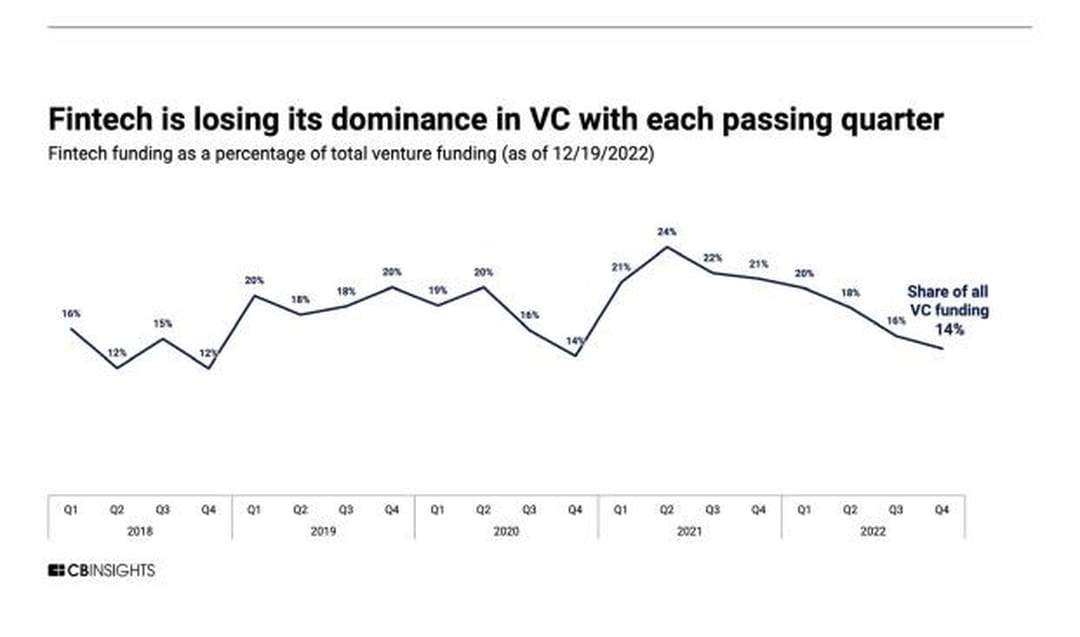
Another tactic used by fintech companies to ensure some stability revolves around a new target audience: companies. A transition to BtoB that should be a growth vector in 2023.
6. The sense of smell becomes digital
Digitize and recreate the scents in the metaverse. This crazy concept could well take shape in 2023. Google’s artificial intelligence team announced last September that it had used machine learning to associate molecules with perceived odors. Companies like Aromyx or Aryballe have raised $17 and $18 million respectively to develop projects for the olfactory detection of disease, explosives or food ripeness. Airbus has even extended its partnership with US start-up Koniku for its technology to detect explosives.
7. Household robots: Amazon and start-ups are already at work
With a market worth 22 billion dollars (20.5 billion euros), household robots are well on their way to conquering living rooms. Disruptive inventions, like Amazon’s Labrador Systems, which is due to hit the market in 2023 and help people with chronic diseases by wearing a few everyday items. Home appliance giant Dyson also entered the market in mid-2022 with a prototype assistant robot for household tasks. Another example of a robot already in senior homes: ElliQ, an artificial intelligence developed by Intuition Robotics, capable of discussing, joking and suggesting habits for good health.
8. Virtual power plants for energy saving
The increasing demand for renewable energy is driving the development of decentralized energy systems, virtual power plants (VPPs). The goal: to optimize the redistribution of energy from a network of common sources (residential solar panels, wind farms, etc.) thanks to the cloud and AI.

In October, U.S. photovoltaic panel supplier Sunrun deployed the system in Massachusetts, New Hampshire, Rhode Island and Vermont, making these regions the first to adopt the technology on this scale.
9. Technology at the service of menopause
From connecting with a specialist to home delivery of medication to personalized advice to manage the effects of menopause, the tech world is working to ease access to quality menopause treatments. The $7 billion start-up Ro generated a fundraising of no less than $150 million in early 2022.

Other companies, such as 51 Apparel, which makes temperature-regulating clothing for menopausal women, are present in the market.
10. India, a new tech territory
India, the future most populous country in the world in 2023, is attracting investors. Various sectors are involved, such as renewable energy production, digital payments ($135 billion in volume per month in the territory) and B2B segments such as e-commerce platforms, corporate banking services or infrastructure of the cloud. By 2022, nearly 7% of new global unicorns came from India.
11. Regenerative agriculture as an alternative to conventional production
The global demand for more environmentally friendly products is forcing agtech companies to work harder to find solutions to restore the soil while reducing the use of synthetic pesticides and fertilizers. Several food and fashion companies have started investing: Nestlé, PepsiCo or Patagonia.
Commentaires
Enregistrer un commentaire