
Zap Autonews Green Paris Motor Show 2022: Dacia Jogger Eco-Smart Hybrid (2022)
A hybridization naturally has multiple sources. In cars, hybridization is mainly determined by the combination of a combustion engine with one or more electric motor(s). With the announced transition to all-electric, it takes on the role of stage, that of progressive electrification. For non-electric vehicles, the word “hybrid” appears everywhere, almost like a passport to market acceptance. So it must be admitted that certain uses of the term prove to be somewhat offensive. Sometimes a simple “Start & Stop” system for automatically cutting off and restarting the engine is enough for the manufacturer to qualify its model as a “hybrid”.
The case of mild hybridization
We can start a little more precisely to speak of a hybrid model with “light” or “microhybridization” hybridization. In this case, the system that turns off the engine at standstill is associated with a small additional battery of 24 volts or 48 volts, which sometimes makes it possible to turn it off while driving by switching to automatic “freewheel” mode , which powers the onboard electronics while the thermal blockage is stopped and relieves them during the start-up and acceleration phases by providing a small excess of power. But the vehicle still cannot run on electricity alone.
Among the different types of hybridization, therefore, there are three general levels:
- mild hybridization
- non-rechargeable hybridization
- rechargeable hybridization.
But what then is a “self-charging” hybrid car, as presented by various manufacturers?
Self rechargeable, not rechargeable, matter of perspective
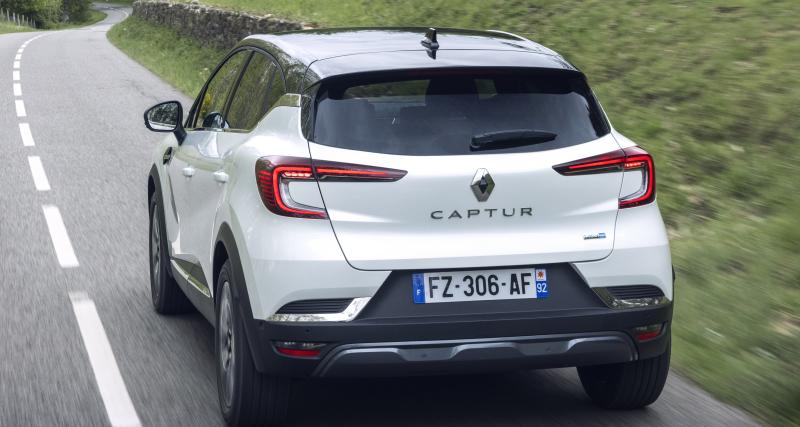
Illustration photo – Renault CapturCredit photo – Renault
There is a battery in a car that runs entirely or partly on electricity. So you have to charge it once. For a 100% electric car or a plug-in hybrid, charging is associated with plugging in a cable connected to the power grid (or to a generator).
That is why a so-called “rechargeable” hybrid car always has a charging point. Models with mild hybridization or “non-rechargeable” hybridization therefore do not have a dedicated charging hatch. But since it is still necessary to charge them, this action is managed by the vehicle itself.
Thus, the electricity that powers the battery is produced in two ways:
- During braking and deceleration, the weight of the vehicle drives the electric motor(s) which, like any electric motor, generate electricity in turn
- By the rotation of the heat engine, which is connected to the main electric motor or to a smaller additional electric motor whose main role is to produce electricity (on the same principle as a dynamo).
These are the two methods behind the term “self-charging”. Yet all electrified cars charge themselves, whether they are plugged in or not, whether they are micro-hybrid or 100% electric.
Therefore, when talking about self-charging or non-charging hybrids, these formulations may seem overused. They both denote a hybrid vehicle that can run in 100% electric mode without a charging point. Therefore, the choice of these two imprecise names serves more to distinguish this type of hybridization from “rechargeable” hybrids, primarily powered by cable.
More precise English terms
In the end, the fairest thing is to rely on English terms. In fact, these do not mention the concept of tax. Plug-in hybrids are therefore called “plug-in hybrids” (PHEVs), literally “plug-in hybrids”.
They therefore oppose both “mild hybrid” (MHEV) and “full hybrid” (FHEV), respectively “moderate hybrid” and “complete hybrid” in good French.
Note that “FHEV” hybrids are sometimes referred to as “HEV”, simply “hybrid” vehicles. The letters “EV” always stand for “Electric Vehicle” since a hybrid car is also an electric vehicle in a sense.
What are the “full hybrid” models on the market?
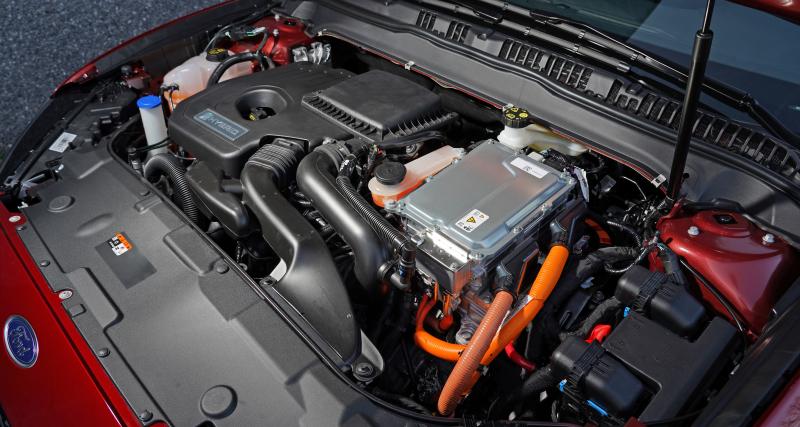
Illustrative photo – Ford MondeoPhoto credit – Ford
Here is the current list of “full hybrid” FHEV models on the market, so “self-rechargeable” or “non-rechargeable”, your choice:
Ford’s range of hybrid vehicles
- Ford Kuga Hybrid FlexiFuel FHEV E85
- Ford Kuga Hybrid I-AWD FHEV
- Ford Mondeo Hybrid
Hybrids in the Honda catalog
- Honda Jazz e:HEV
- Honda Jazz Crosstar e:HEV
- Honda HR-V e:HEV
- Honda Civic e:HEV
- Honda CR-V e:HEV
Hyundai cars equipped with hybrid technology
- Hyundai Ioniq hybrid
- Hyundai Kona hybrid
- Hyundai Tucson hybrid
- Hyundai Santa Fe hybrid
Kia hybrids
- Kia Niro hybrid
- Kia Sportage hybrid
- Kia Sorento hybrid
The hybrid range at Lexus
- Lexus UX250h
- Lexus NX350h
- Lexus ES300h
- Lexus RX450h
- Lexus RX-L450h
- Lexus LS500h
- Lexus LC500h
Only one hybrid Mazda in the catalogue
Nissan cars equipped with a hybrid engine
- Nissan Juke Hybrid 143
- Nissan Qashqai e-Power 190
- Nissan X-Trail e-Power 204
- Nissan X-Trail e-Power 213 e-4ORCE
Renault’s hybrid offering
- Renault Clio E-Tech Hybrid 145
- Renault Captur E-Tech Hybrid 145
- Renault Arkana E-Tech Hybrid 145
- Renault Austral E-Tech Hybrid 160
- Renault Austral E-Tech Hybrid 200
Subaru hybrids
- Subaru Impreza e-Boxer
- Subaru XV e-Boxer
- Subaru Forester e-Boxer
Suzuki hybrid vehicles
- Suzuki Swace 1.8 e-CVT Hybrid
- Suzuki Vitara 1.5 Dualjet Hybrid
- Suzuki Vitara 1.5 Dualjet Hybrid AllGrip
- Suzuki S-Cross 1.5 Dualjet Hybrid
- Suzuki S-Cross 1.5 Dualjet Hybrid AllGrip
Toyota’s hybrid models
- Toyota Yaris 116h
- Toyota Yaris Cross 116h
- Toyota Yaris Cross 116h AWD-i
- Toyota C-HR 122 hours
- Toyota C-HR 184 hours
- Toyota Corolla 122 hours
- Toyota Corolla 184h
- Toyota Corolla Touring Sports 122 hours
- Toyota Corolla Touring Sports 184h
- Toyota RAV4 218 hours
- Toyota RAV4 222h AWD-i
- Toyota Camry 218 hours
- Toyota Highlander 248 hours AWD
to summarise
Our journalist-tester explains and deciphers three different names to define the same technology on board our cars: the self-charging hybrid, the non-charging and the full hybrid.

Commentaires
Enregistrer un commentaire