
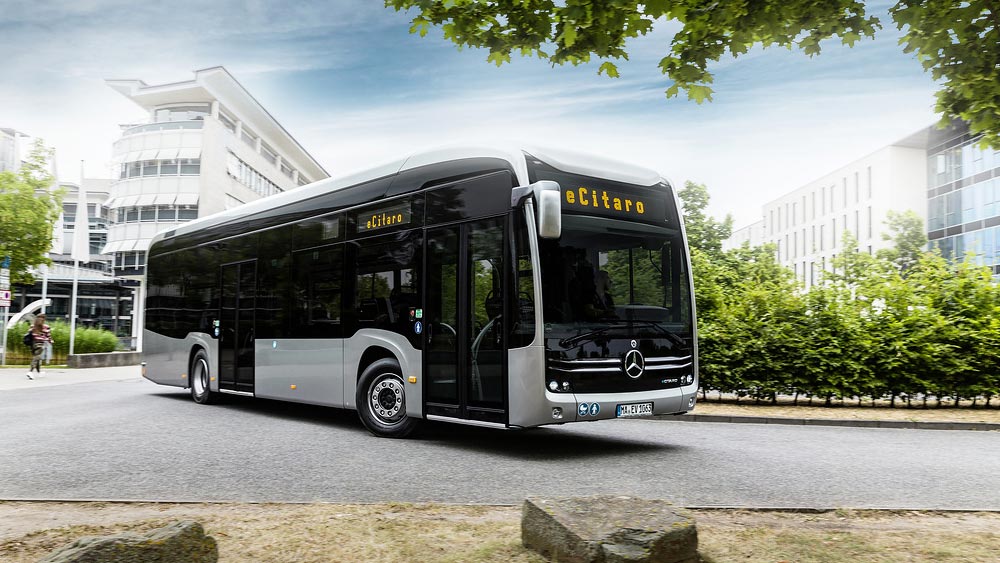
The Mercedes eCitaro electric bus continues to convince a few cities and carriers. If the units that are put into service only cover 150 to 200 km per day for the most part, the automatic transmission also knows how to meet much higher requirements for the daily rounds.
Make kilometers by bus and electric coaches
Many still think that the electric car is reserved for urban use. Even more people believe that a battery-powered bus cannot cover any significant mileage in 24 hours.
However, Flixbus had already shown the opposite by mobilizing two Yutong ICe 12 electric coaches from April 2018 to cover the 150 km line between Paris and Amiens in the Somme. Or 300 km there and back to swallow during the day.
With an area of 7,268 km2, the Sjælland region, Denmark, has more than 800,000 inhabitants. Of the 17 municipalities, Køge (a port city south of Copenhagen) and Stevns are about 50 km apart at the shortest distance, or 100 km on paper for a round trip. It is the longest road public transport line in existence in Denmark and is classified as urban transport.
588 kWh
The loop, operated by the Vikingbus company, will run several times a day with the same buses. To the point, for each, of regularly making more than 500 kilometers a day. This service, the operator with 450 heavy passenger transport vehicles, reserves them for Mercedes eCitaro electric buses.
Vikingbus has ordered a total of 31 units of the electric version of its showpiece bus model from the German manufacturer: the standard 12-metre Citaro. They will be equipped with the latest generation of high energy density NMC lithium ion batteries (nickel, manganese, cobalt), in the superior version.
Each vehicle has an energy capacity of 588 kWh. This represents more than 11 Renault Zoé 50 kWh combined. This new fleet will not be put back into service immediately. The machines will be delivered between the years 2023 and 2024. No information has been communicated about the charging methods: places, means, frequency?
Also in Vienna
The Austrian city of Vienna is also interested in the Mercedes eCitaro. As proof, this order just registered for 60 units to be delivered between 2023 and 2025. For them, the operator Wiener Linien has opted for more modest packages that individually offer 392 kWh of energy capacity.
The chosen model is also the standard 12-metre model, in the version with a lowered flat floor that facilitates the boarding of people with reduced mobility. Their pantograph mounted on the roof allows charging up to 300 kW. Thanks to this order, the Austrian company plans to convert 9 lines to electricity from the more than 100 loops it manages.
Last year, users were able to experience silent mobility for 2 weeks on 3 routes with articulated models. In total, the network extends over approximately 850 kilometers. It has 4,230 stops. Gradually, the 127 bus lines must be converted to electric.
Build a specific repository
While awaiting delivery of the 60 buses ordered from Mercedes, Wiener Linien will convert one of its locations into a depot to house this connected fleet. It will take the place of the former car park in Siebenhirten, in the south of the Austrian capital, and should be inaugurated at the end of next year with around fifty locations. The electric buses are charged, maintained and repaired on site.
The building is innovative. Photovoltaic panels installed on the roof will provide it with electricity. Residual heat from the chargers will also be used. It will be used to heat the workshop. Still in Vienna, the Spetterbrücke site will also be adapted to connected mobility, fully equipped with charging infrastructure.
Stations will also be built along the routes of the new electric buses. Those hitherto reserved for Wiener Linien metros and trams will also provide part of the required energy. Note that the Austrian operator claims to take full advantage of electricity from renewable sources.
Commentaires
Enregistrer un commentaire