
Was the End of Restrictions on Chinese Big Tech Just a Bait? Now Beijing is taking 'golden shares' from them - Business AM

by Olivier Deelen
published on Bee •
5 minutes read
published on Bee •
5 minutes read
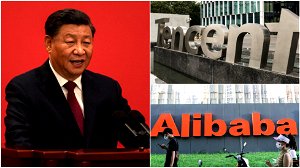
Alibaba and Tencent: two of the largest Chinese technology companies. And two of Beijing’s favorite targets. Now the authorities are using another strategy to keep them under control: buying “gold stocks”.
Why is this important?
If some thought 2023 would be the year of recovery for China’s big tech companies, they may be wrong. With the country returning to the pre-Covid era and easing Big Tech regulations, Beijing seems to have a different idea of how to control them.In the news : Beijing buys “golden shares” of Chinese Big Tech.
- The Chinese government is busy buying “golden shares” of the country’s tech giants through funds or companies it backs.
- It’s already been done for Alibaba. For Tencent, it’s on.
The explanation : What are “golden shares”, what are they?
- The “golden shares” bought by Beijing correspond to about 1% of the capital of the companies involved. So a priori this is not very important. But there’s a but.
- As explained by Financial times, these stocks, known in China as “special management stocks”, have special rights to certain important decisions. For example, they can allow the holder to:
- Get a seat on the company’s board of directors.
- Have a say in the company’s business strategy and investment plans, including potential mergers and acquisitions.
- To review or even check the content produced by the company.
- In other words, although they represent only a very small part of the company’s capital, these shares confer a very significant power on their holder.
- That Beijing attacks it at Alibaba and – soon – at Tencent is therefore far from trivial.
Precedents
The detail : two units of Alibaba already in Beijing’s wallet.
- For the first time, Alibaba reported that about 1% of its equity has been taken over by Chinese government-backed entities in two of its divisions.
- An investment vehicle of the state-owned Zhejiang Media Group has taken gold shares in Youku Film and Television, a video streaming company.
- WangTouSuiCheng – a Beijing-based entity under the China Internet Investment Fund (CIIF) established by the Cyberspace Administration of China (CAC) – acquired gold-plated shares in Guangzhou Lujiao Information Technology, with the main objective being “research and experimentation”
- Here it is the control of the UCWeb browser that would be targeted.
- According to information from FTTencent is next on the list.
- Discussions are ongoing, but it seems certain that gold shares of one of the Chinese gaming giant’s main operating units will soon be bought by Beijing
- “The state is not going away, this is the trend for the future,” says a source familiar with the matter.
And after that ? ByteDance hints at what could happen.
- While this is the first time the Chinese government has gotten its hands on gold shares of Alibaba and Tencent, it has already used a similar strategy with other Big Techs, such as Weibo and ByteDance (best known for TikTok).
- In April 2021, Beijing acquired 1% of Beijing ByteDance Technology unit’s capital through three financial vehicles.
- This had enabled the government to place a Communist Party official on the branch’s board of directors.
- The man was best known for one day publishing on his Weibo account: “I have only one wish: that one day I can chop off the dog’s head of liberal Chinese with Western values. May the Chinese traitors who preach so-called “human rights and freedom” go to hell! “.
- It turned out that he had gained control over the content of several ByteDance apps, including “TikTok’s sister” Douyin, among other things.
- On the stock exchange, shares of Alibaba and Tencent fell slightly in the hours following the disclosure of this information.
Source link
Commentaires
Enregistrer un commentaire